
Generate highly complex mechanical SimReady assets with Mad Max
Today we’re releasing Palatial Mad Max, a major update to our parametric agent and its highest-fidelity generation setting. The update improves dimensional accuracy, curved geometry, and mesh topology, with detailed, articulated components for interaction in simulation.
Palatial’s asset agent coordinates research, modeling and physics agents to generate SimReady assets based on real world objects. Mad Max extends its parametric modeling capabilities, focusing on the geometry and mechanical detail needed for robot manipulation.
Simulations that mirror reality
An object’s dimensions and surface geometry affect how a robot interacts with it. A handle needs enough clearance for a gripper. Components in an assembly need to fit together. An articulated mechanism needs to represent the parts that move during a task.
Mad Max improves the representation of these details through more accurate dimensions, curved surfaces, and refined mesh topology. It generates articulated components that allow moving parts to be represented and manipulated individually in simulation.
These capabilities support work on contact-rich manipulation, including assembly and bimanual tasks. In these settings, the asset needs to capture how components move and make contact throughout an interaction.
High fidelity mechanical and visual detail
Mad Max’s modeling improvements work alongside Palatial’s physics capabilities to prepare assets for manipulation. Grasp affordance maps and stable contact normals provide information relevant to how a robot holds an object and interacts with its surfaces.
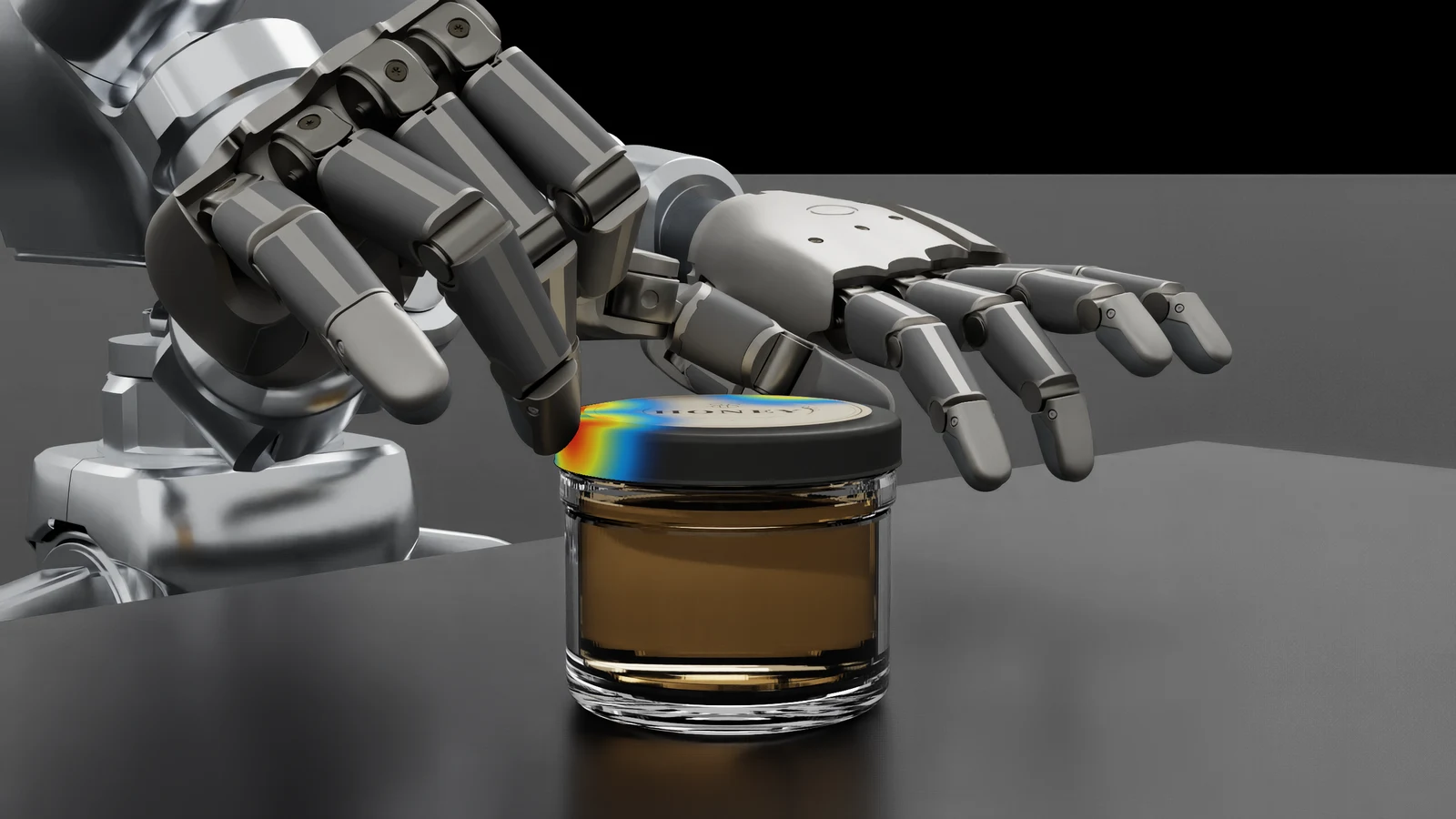
Affordance tagging marks where an object is meant to be grasped, such as a handle, a rim or an edge, so that training can tell the robot where to take hold. A heat map visualizes the resulting grasp predictions over the asset, from lower to higher confidence.
Stable contact normals come from a stable solve. When an asset has correct physical properties, well-built collision proxies, and appropriate simulator settings, the object does not jitter, and the contact normals the solver reports stay consistent and better approximate real-world contact forces. Poor collision geometry or wrong solver parameters cause jitter, and the normals turn noisy with it. Palatial's physics workflow prepares the properties, proxies and settings that produce the stable solve.
Together with articulation, these capabilities help prepare assets for tasks that involve sustained contact or interaction between moving components.
PBR materials and semantic meaning
The broader Palatial workflow also includes PBR shaders and semantic tagging. These serve different parts of the training process and complement Mad Max’s geometric and mechanical detail.
Physically based rendering, or PBR, represents how materials respond to lighting. For camera-based robot policies, material appearance is part of the visual input used during training. PBR shaders support more realistic rendering of an asset’s surfaces.
Semantic tags provide labels for use in reinforcement learning datasets and downstream data pipelines. They allow information about an asset to accompany its geometry, materials, and physics properties.
In addition, each part carries a non-visual material tag, so assets can support a broader range of sim sensor suites such as lidar, radar, and ultrasonic.
Less manual preparation for more demanding assets
Researchers often handle modeling, mesh cleanup, articulation, collision tuning, materials, and annotation as separate preparation steps. Palatial brings that work into a single coordinated asset-generation workflow.
The ambition is straightforward: spend less time preparing the objects in your simulation and more time teaching robots what to do with them.